Dual-Attention BiLSTM for Interpretable Forecasting of Treatment Toxicities
Dual-Attention BiLSTM for Interpretable Forecasting of Treatment Toxicities
Anyimadu, E.,Zhang, X.,Fuller, C. D.,Marai, G. E.,Canahuate, G.
- Location: Atlanta, Georgia
- PDF: bilstm.pdf
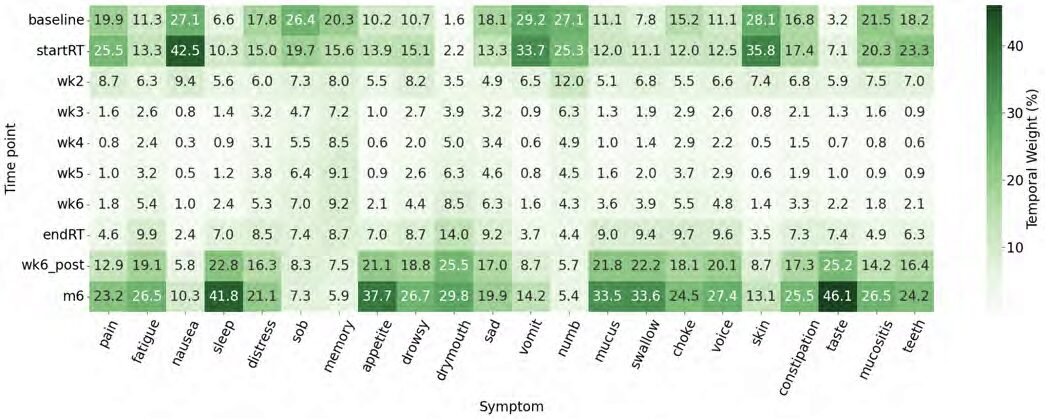
- Caption: Heatmap showing normalized attention weights assigned to historical time points for each predicted target symptom, where higher values indicate greater influence of the earlier time point on the month 12 forecast.
Longitudinal patient-reported outcomes (PROs) provide crucial insights into symptom progression and treatment response in oncology, enabling more personalized and anticipatory care. Deep learning models such as Bidirectional Long Short-Term Memory (Bi-LSTM) networks have recently been applied to forecast symptom trajectories from PRO data. While these models offer improved predictive performance over traditional statistical methods, they often fall short of capturing the evolving clinical relevance of individual symptoms or the varying influence of specific time points in the patient journey and lack clinical interpretability.
In this work, we propose an attention-enhanced Bi-LSTM model that incorporates dual attention mechanisms at the item and temporal levels to selectively emphasize the most informative symptom-time interactions. This architecture addresses the limitation of uniform input weighting, enhancing both forecasting accuracy and interpretability. Evaluated on a longitudinal PRO dataset collected at a major cancer center, our model outperforms conventional Bi-LSTM approaches in predicting 12-month symptom severity and offers clinically meaningful insights into symptom evolution. These findings highlight the potential of attention-based temporal modeling to support personalized, timely decision-making in oncology care.
Index Terms: Longitudinal Forecasting, Patient-Reported Outcomes, Deep Learning, Dual Attention, Bidirectional LSTM, Interpretability
Citation: Anyimadu, E., Zhang, X., Fuller, C. D., Marai, G. E., Canahuate, G., Dual-Attention BiLSTM for Interpretable Forecasting of Treatment Toxicities, BHI 2025 IEEE-EMBS International Conference on Biomedical and Health Informatics, Atlanta, Georgia, 2025-10-26.