Evaluating Dimensionality Reduction for Patient-Reported Outcome–Based Survival Modeling in Patients With Head and Neck Cancer
Evaluating Dimensionality Reduction for Patient-Reported Outcome–Based Survival Modeling in Patients With Head and Neck Cancer
Anyimadu, E.,Wang, Y.,Moreno, A. C.,Fuller, C. D.,Zhang, X.,Marai, G. E.,Canahuate, G.
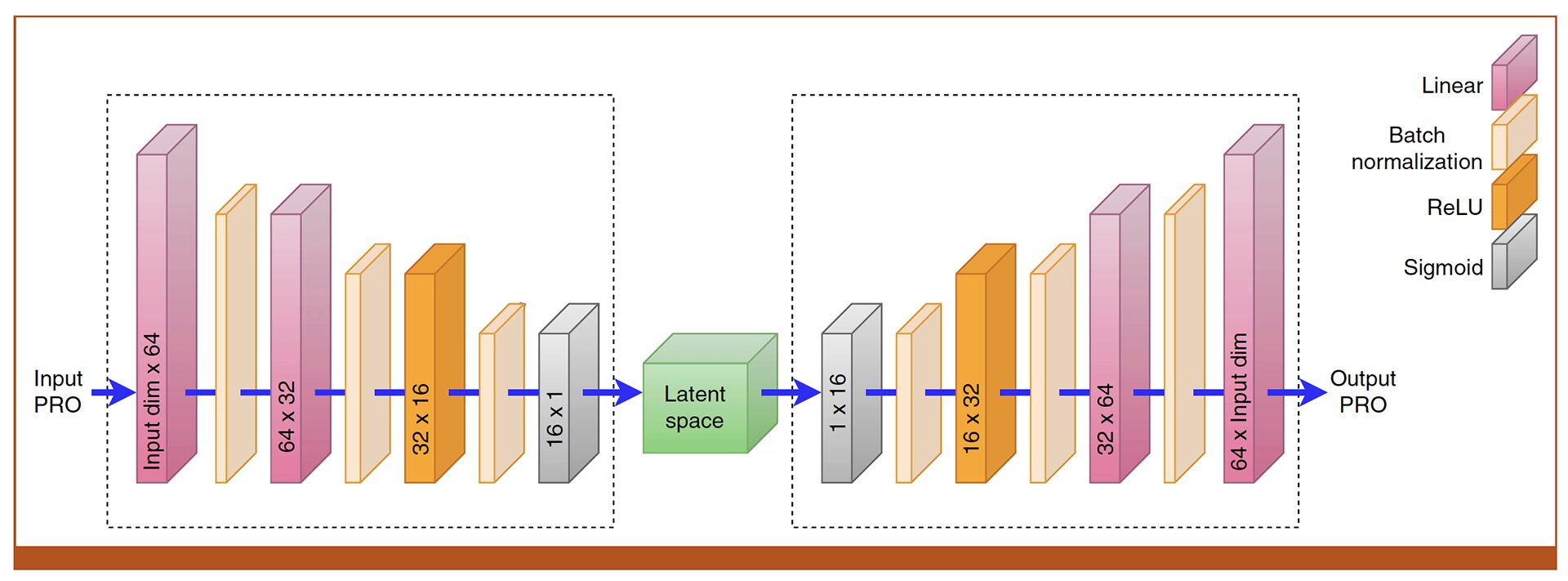
- Caption: AE architecture for dimensionality reduction, featuring linear, ReLU, and sigmoid activation functions with batch normalization applied between activation layers.
This study aims to improve survival modeling in head and neck cancer (HNC) by integrating patient-reported outcomes (PROs) using dimensionality reduction techniques. PROs capture symptom severity across the treatment timeline and offer key insights for personalized care. However, their high dimensionality poses challenges such as overfitting and computational complexity. This work focuses on transforming and incorporating PRO data to enhance model performance in HNC. Cox models incorporating PCA and AE outperformed the clinical-only reference model for both Overall Survival (OS) and progression-free survival (PFS). The principal component analysis PCA-based model achieved the highest C-indices (0.74 for OS and 0.64 for PFS), followed by the autoencoders AE model (0.73 and 0.63) and the clustering model (0.72 and 0.62). Time-dependent area under the curve (AUCs) reinforced these results, with PCA showing the highest average AUC over 36 months. All models were well-calibrated, with low Brier scores. Key predictors included age, disease stage, and tumor subsite. Dimensionality reduction techniques improve survival prediction in patients with HNC by effectively incorporating PRO data, potentially providing greater insights into more personalized treatment strategies.
Citation: Anyimadu, E., Wang, Y., Moreno, A. C., Fuller, C. D., Zhang, X., Marai, G. E., Canahuate, G., Evaluating Dimensionality Reduction for Patient-Reported Outcome–Based Survival Modeling in Patients With Head and Neck Cancer, J of Clinical Oncology, 2025-08-01. https://doi.org/10.1200/CCI-25-00069