VR Post-Stroke Hand Opening Rehabilitation: An Approach Utilizing Virtual Reality, Body Orthosis and Pneumatic Device
VR Post-Stroke Hand Opening Rehabilitation: An Approach Utilizing Virtual Reality, Body Orthosis and Pneumatic Device
Luo, X., Kenyon, R., Kamper, D.
- PDF: xluo-icadi06.pdf
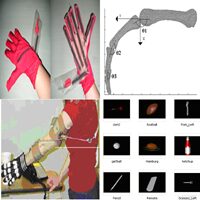
- Caption: The hand kinematics model, assistive devices and vitual objects for grasp
- Credit: Jake Streepy
Stroke is among the leading causes of adult disability in Europe. While finger flexion often appears spontaneously within weeks after a cerebrovascular accident, finger extension is less likely to exhibit recovery and creates difficulty for voluntary hand opening. A study from the UK reports that over half of the subjects studied depended on others for assistance six months post-stroke.
We present a training environment for rehabilitation of hand opening in stroke survivors. This environment integrates augmented reality, assistive devices and the process of repetitive training of grasp-and-release tasks. The AR element utilizes head mounted display and virtual objects for reach-and-grasp task training. The assistive device consists of either a body-powered orthosis (BPO) or a pneumatic-powered device (PPD), both of which are incorporated into gloves. The 6-week grasp-and-release training sessions are performed 3 times a week and 30 minutes long for each.